Totaalleverancier voor grootformaat printoplossingen

NL : +31 (0)76 820 08 30 | Belux : +32 (0)89/46.05.60

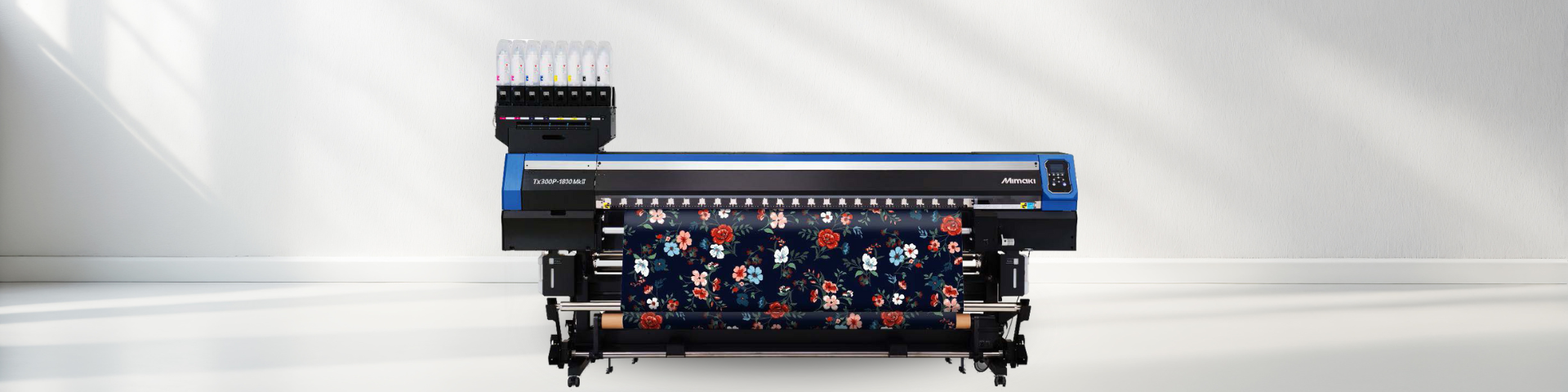
Featured image - Mimaki TX300P-1800MKII - Hybrid textile printer

Mimaki TX300P-1800MKII - Hybrid textile printer

The Mimaki TX300P-1800MKII hybrid textile printer combines direct-to-textile and transfer printing in one versatile system. Perfect for fashion, interior textiles and soft signage. This printer delivers vibrant colors, sharp details and optimum flexibility for any textile application.

Mimaki TX300P-1800 MkII

The Mimaki TX300P-1800 MkII is a large-format hybrid printer that can print both directly on textiles and dye-sublimation transfer paper. With versatile ink sets, its wide print width and robust utility features, it offers production flexibility for fashion, decor, flags and more.


Key features:


  • Hybrid media: switch between direct printing on textile and printing on transfer paper via interchangeable printing plate.
  • Wide range of inks: supports pigment, reactive, acid, dispersion and sublimation ink types, including combinations with two inks.
  • Large print width: up to ~1,920 mm (textile) / ~1,940 mm (transfer paper) for large-format printing.
  • High print quality and speed: multiple resolution modes (360-1440 dpi), MAPS4 anti-banding, variable dot, high head gap support.
  • Continuous printing features: Nozzle Check Unit, Nozzle Recovery System, Bulk Ink System (MBIS3) with large ink packs for less downtime.

Frequently Asked Questions

What does "hybrid" mean in this printer and how does it switch between textile and paper?

"Hybrid" means that the TX300P-1800 MkII supports both direct to textile printing and dye-sublimation transfer printing (on paper) in one machine. The user can change the printing plate: a vacuum printing plate is used for printing on transfer paper (to prevent cockling or lifting), and the normal open (or textile) printing plate + textile feed mechanism is used for fabric. This operation is manual and relatively quick and does not require a large downtime. This flexibility makes it possible to print polyester via sublimation, or natural fiber/mixed fiber via reactive, acid or pigment inks, all on the same machine.

Which ink types should I choose for my application: sublimation, reactive, pigment, acid or dispers?

It depends on the type of fabric, intended use, durability and finish:

  • Sublimation inks (Sb420 or transfer Sb411) are ideal for polyester or polyester-rich blends. They offer excellent wash fastness and outdoor performance and vibrant colors.
  • Reactive dyes (Rc400, Rc500) produce vibrant colors on cotton and other cellulose fibers; very good for fashion apparel.
  • Acid dyes (Ac400) are suitable for silk, nylon or other protein/nylon fibers and produce bright color tones.
  • Pigment ink (TP400) offers excellent wash and light fastness, more forgiving on mixed fibers or when the dye is more difficult to fix. Often used in interior decoration, home textiles that need frequent washing.
  • Disperse dye (Dd400) is often used for polyester fabrics, especially for heavy use, UV exposure or durability.

Choosing the right ink also depends on cost, required finish (e.g., steaming, washing) and compliance with environmental/safety regulations.

What are the expected print speeds and how does print quality compare?

The TX300P-1800 MkII offers several print modes. In draft / low-pass modes (e.g., 2-pass, 4-color), you can achieve high speeds (≈ 66 m²/h or more), especially with sublimation inks. As you use more colors (6-8 colors), higher resolution (720, 1080, 1440 dpi) or more transitions, the speed drops. High-quality or photographic prints, for example, will take much longer per square meter. It's a balance: choose the mode depending on end-use requirements - if you need fast turnaround time, draft modes are sufficient; if you need top color, detail and durability, choose slower modes.

How thick cloth/how heavy media can this printer handle?

Media thicknesses up to about 1.0 mm are supported. Roll weights up to ~ 40 kg (≈ 88 lb) are allowed; media roll diameters are limited to ensure stable feeding. The printer also has tension control (front and rear tension bars) to accommodate changes in roll diameter, and feed stability is designed into the textile feed mechanism. In addition, when printing on thicker / raised fabrics or textured surfaces, the head gap can be adjusted (~2-7 mm) so that the print heads do not touch the media, which helps prevent damage and maintain image clarity.

What about color consistency, banding and print quality for large runs?

Mimaki has incorporated several technologies to maintain print consistency and quality. MAPS4 reduces banding by cleverly overprinting or adjusting the drop deposit at problematic swath boundaries. The Nozzle Check Unit (NCU) detects clogged nozzles; the Nozzle Recovery System (NRS) takes over by using good nozzles as needed. The bulk ink supply system (MBIS3) with large containers helps reduce ink changes and possible variation from machine to machine or within long runs. Also important are environmental control (temperature, humidity) and consistent fabric preparation. For long runs, using the same ink sets, the same media and the same RIP workflows helps maintain color repeatability.

What are the requirements for power, floor area and operating environment?

The machine requires single-phase alternating current, either in the AC100-120 V or AC200-240 V range (region-dependent). The power consumption is about 1.44 kW in 100 V mode and 1.92 kW in 200 V mode. The operating environment is specified around 20-30 °C, with relative humidity between 35-65% RH (non-condensing). The floor area is considerable: about 3,200 × 965 × 1,857 mm (W × D × H), the weight is about 260 kg. Good ventilation and stable environmental conditions help with ink drying, fabric handling and consistent output.

What is the cost of ownership (ink, maintenance, waste)?

While exact costs depend on usage, media, geography and labor, key cost factors include:

  • Ink use and type: More expensive ink types (reactive, acid, pigment) tend to cost more per liter than basic sublimation. Dual or hybrid modes may require more careful ink management.
  • Media costs & finishing: pre-treatment, washing, steaming, pressing or fixing the fabric may incur additional costs. Transfer paper for sublimation modes is also extra.
  • Downtime & maintenance: features such as NCU, NRS, bulk ink system help reduce downtime. Consumables such as print heads, wipers and filters need to be replaced over time.
  • Operating costs: Power, compressed air (if used in finishing), heating or cooling as required.

In the long run, the hybrid capabilities and large ink packs will lower the cost per square foot, especially if you maximize the versatility of the printer (doing both textile and transfer work) to keep it busy rather than leaving it idle between specific jobs.

What are the environmental/safety/regulatory certifications?

This printer complies with a number of international standards: CE (EMC, Low Voltage, Machinery Directive, RoHS), CB scheme, REACH, VCCI Class A, FCC Class A, ETL / UL 60950-1, among others. Some inks (Sb420, Sb411) are OEKO-TEX certified. These ensure safety (electrical, mechanical), reduced environmental impact and suitability for clothing/home textiles with human contact.

How does this printer compare to alternatives (other printers in the Mimaki TX, TS, or other brands)?

The hybrid feature is one of its strongest differentiators. Many textile printers are either direct-to-fabric only or sublimation transfer only; combining both in one machine gives flexibility. Compared to older TX300P (non-MkII) models, the MkII adds better media transport, a larger head opening, more ink combinations and improved workflow options. Compared to competing brands, you should compare not only machine costs, but also total cost of ownership, productivity (speed, uptime), ink costs, media compatibility, support and after-sales service. Depending on your main application (volume, fabric types, finishing), other machines may be more cost-effective, but the TX300P-1800 MkII offers versatility that can reduce the need to buy/maintain multiple systems.


Documents

Data Table

Print width (textiles)

~1,920 mm (≈75.6 in)

Print width (Transfer Paper / Hybrid Mode)

~1,940–1,950 mm, depending on the mode

Supported ink types

Sublimation dye (direct & transfer) (Sb420, Sb411), Reactive dyes (Rc400 / Rc500), Acid dyes (Ac400), Disperse dye (Dd400), Textile pigment (TP400)

Print resolution Modes

360, 540, 720, 1,080, 1,440 dpi (varies with ink/mode)

Maximum media thickness

up to ~ 1.0 mm

Maximum roll weight

~40 kg per media roll (≈88 lbs)

Power supply/consumption

Single-phase AC100-120 V or AC200-240 V; ~ 1.44 kW (AC100V), ~ 1.92 kW (AC200V)

Dimensions and weight

Approx. 3,200 × 965 × 1,857 mm (W × D × H); weight ~ 260 kg

Interfaces

USB 2.0 Hi-Speed, Ethernet 1000BASE-T

Certifications

CE, REACH, CB, VCCI Class A, FCC Class A, ETL/UL 60950-1, RoHS, etc.

Why Dimix?

  • Ordered today before 15:30; delivered tomorrow
  • No shipping costs from 290 €
  • Net prices after login
  • Extensive advice
  • Experienced technical service