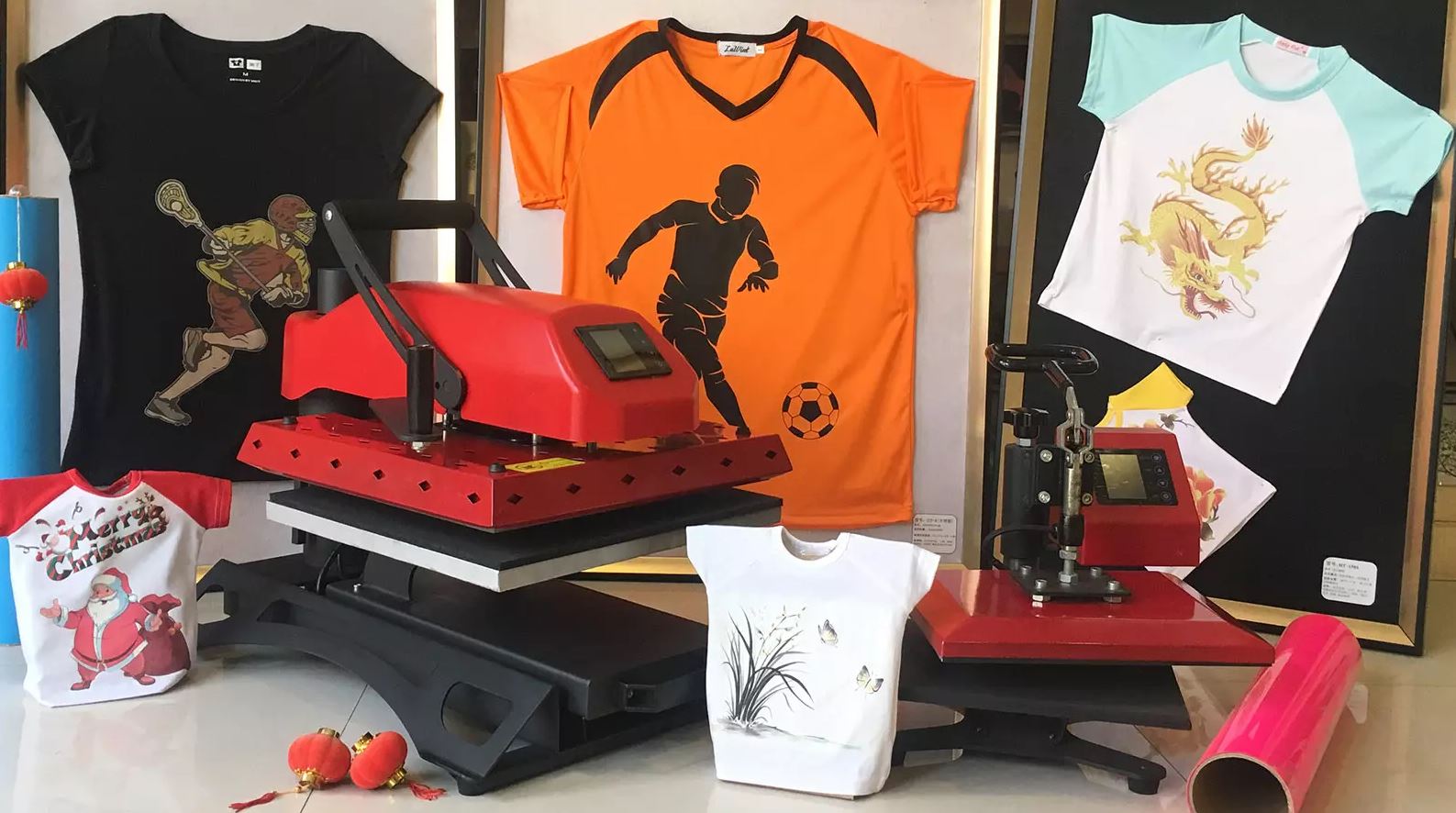
Buy transfer press?
Buying a transfer press for a textile printing business, sports club or hobby? With all the presses available, it can be difficult to choose the right transfer press (also known as a heat press). Where should you start? What should you pay attention to? In this handy tip list, we explain how to select the best transfer press. Whether you're a start-up or a seasoned textile printer.
How often do I need it?
The more often you need a transfer press or other device, the more important it is to you in your production process. A machine you rarely use has different requirements than a machine you use every day and all day.
In terms of ease of use, you have more requirements for a machine that will be used frequently.
If you do not yet know exactly how often you will use a transfer press, for example because you are just starting out, a large investment is not necessary. If your business is going well, you'll quickly earn back a cheap entry-level model and you can invest in a more luxurious model, keeping the entry-level model as a reserve.
Basic or "all the trimmings"
With basic versions, you literally have to do everything yourself. There is no automation and you can often only set one program. It also takes quite a bit of force to open and close the press. When you choose a semi-automatic, it stays closed with a magnet and pops open automatically when the counter expires. So all you have to do is click it against the magnetic contact and not pull it through a spring tension. Also, with these models you can read the pressure and post-press times can be set. With all machines a signal sounds when the time is up, from a semi-automatic the clamp opens automatically which prevents burning of the glue.
With "all-in-one" machines, pneumatics often apply pressure with the push of a button. These machines are usually equipped with two tables between which can be changed. Different programs can also be set. The ease of use is great, the manual load is much lower and production goes up. Of course, this comes at a price. Simpler is cheaper.
Good underplate of cast iron
Lots of "cheap" transfer presses roam the Internet. These are often cheap because they are made of light metal. A good transfer press has a cast iron bottom plate and should be difficult to move because it is so heavy.
The bottom plate is subjected to a lot of pressure and should be able to last a long time. For this reason, it must be made of heavy quality cast iron. If this is not the case, the plate can start to deform and bend under the pressure and heat. As a result, the pressure is no longer the same in all places.
The glue does not penetrate the fabric properly in those places and this adversely affects the final result.
Evenly heating element
The same applies to the heated top plate. It should have as even a temperature as possible and actually reach the temperature shown on the display.
In cheaper models, the distribution of heat is not good, so the end result can be disappointing. The indicated temperature is also often not reached.
Cheap is expensive in these cases, because a new transfer press must be purchased fairly quickly.
Adjustable pressure
A good (predictable) pressure setting is important because different flex types require different pressures (high, medium, low). When closing the press, this can be adjusted instinctively, but not everyone has the same strength in their arms. This gives you unpredictable adjustments. With the semi-automatic machines, the pressure is indicated by a number from 0 to 9 where 5 is medium. So then it is measurable and predictable.
With a pneumatic press, the adjustment is set and only a button has to be pressed. It can't be more precise.
What else can you look for:
- Interchangeable lower plates: Does a press have this feature? Then you can replace the standard size bottom plates with other sizes. Useful, for example, when you need to put a 10x10cm chest logo or a print on a sleeve.
- Auto-open system: Via a magnetic closure, transfer presses with an auto-open system open automatically after the set press time. Convenient because that way you don't always have to stand by your press and you don't have to open the press manually.
- Open bottom plate: Is the bottom plate of the press open at the bottom? Then you can easily pull textiles around the bottom plate while pressing. That way you don't have to put all the textiles under the press.
- Built-in laser: Does the press have a built-in laser system? Then you can always position film neatly straight onto the textile and then press it.