What is a traditional UV lamp ?
UV lamps used in large format printers to dry UV-curable inks are usually arc lamps using argon & mercury. These lamps are based on a technology developed in the late 19th century and optimized over the years.
Without going into too much detail, the principle boils down to this: Electricity is put between two electrodes, the gas in the lamp creates resistance, the temperature in the lamp quickly increases and the mercury starts to evaporate. A chemical process causes the mercury to produce radiation between 200 and 400 nanometers. By mixing metal halides into the mercury, one can ensure that a lamp will peak in terms of UV power at certain wavelengths with which one can tailor a lamp to the curing properties of a particular ink.
The glass used in a mercury uv lamp is quartz because it is the only type of glass that allows UV light to pass through while being resistant to high temperatures. Using a traditional UV lamp.
When starting up a UV lamp, we first see faint radiation. Most of the electric current is converted to heat so that the mercury can evaporate. Only when all the mercury has evaporated is the optimum UV spectrum reached with which to dry UV inks.
When the lamp is turned off, it must first cool completely and all the mercury must condense before it can be restarted. This can take several minutes. Because that waiting time is a problem, in uv printers that use tradtional lamps, shutters are used that open and close. Only when they are open does the uv light make contact with the ink and curing takes place.
Cooling.
Because of the large heat production of mercury gas lamps, it is necessary to provide advanced cooling systems in addition to shutters. If heat is not dissipated, it will accumulate and the temperature will rise to values that can cause the glass and the housing around it to start melting and even cause a fire. Hence it is very important to check the cooling system regularly.
Lamp wear.
Mercury gas lamps have a limited lifespan. For UV printers, this is usually limited to about 700 to 1000 hours. During the service life, the efficiency decreases significantly as the electrode material sputters away and settles on the quartz glass. This manifests itself as a kind of deposit that reduces the permeability of the glass resulting in less UV energy that can be emitted. The more one turns the lamps on and off the faster this aging process occurs.
Anyone who has a printer with mercury gas lamps should regularly measure the UV output. It is also best to regularly clean the lamp and reflectors with isopropyl alcohol. It is very important not to touch the lamps with your hands, as the grease that remains will burn into the lamp and reduce the UV output.
Environmental aspects of mercury gas lamps.
Of course, mercury gas lamps contain mercury, which is very harmful to the environment. Consequently, these lamps must be disposed of as special chemical waste.
Next, mercury gas lamps are real energy guzzlers. Only a small portion of this energy is converted to UV light. Most of it is converted to heat, which in turn requires cooling, and this again requires a lot of energy.
Older types of mercury gas lamps also produce ozone. This is no longer the case with more recent mercury gas lamps.
LED-UV technology versus traditional UV lamps.
LED-UV lamps, unlike mercury gas lamps, are relatively new. These lamps have only been developed in the last 15 years or so and are made of semiconductors. This technology offers huge advantages over mercury gas lamps.
Traditional UV lamps emit energy in a broad spectrum of wavelengths, only 20% of which is in the useful UV range. More than 50% is in the infrared region which thus results in heat. In contrast, with LED UV lamps, the energy is almost entirely in the UV range.
Traditional UV lamps, as we explained above, have a decreasing efficiency and often need to be replaced after 700 hours. LED-UV lamps on the other hand have a long lifetime. There is basically no wear and tear and in many cases an LED-UV lamp will last the entire useful life of a printer. Because the UV output is also constant, one does not need to measure it, and consequently does not need to purchase any measuring equipment.
LED-UV lamps are constantly turned on and off. This is not possible with traditional lamps because they require a warm-up time and a cool-down time. The aging process is also accelerated each time the lamps are turned on and off. Consequently, traditional lamps need shutters, which is not the case with LED-UV lamps.
LED-UV lamps pose no problem for heat-sensitive materials. Corrugated cardboard, honeycomb cardboard, reboard, ... as well as a number of plastics have the property of curling up or deforming when heated locally. This can then lead to a head crash, which can result in damage to print heads. Because LED-UV printers do not produce heat, this problem does not occur.
UV printers with traditional UV lamps are usually equipped with complex cooling systems with large cooling capacities. LED-UV lamps are also usually provided with cooling, but this is usually limited to simple systems such as some cooling fins with fans mounted on them.
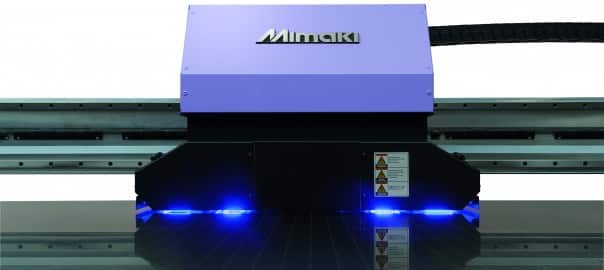
LED-UV lamps consume only a fraction of the energy required by a traditional mercury gas lamp. There is also no start-up time during which energy is consumed and little energy is needed to provide cooling. This saves at least 85% on energy costs. For example, the consumption of the LED-UV lamp including the fans that provide cooling on, say, a Mimaki JFX200 is about 80 watts. A typical mercury gas lamp used on a similar device easily consumes 1200 watts.
The generation of static electricity can have several causes, but the combination of dry air with turbulence caused by moving the printer carriage back and forth is a very important cause. The heat produced by traditional UV lamps dries the air under the carriage causing substrates to become statically charged which can lead to print quality problems. Those who have a flatbed printer with traditional lamps should therefore provide a professional humidification system to counteract this.
Safety aspects.
Traditional mercury uv lamps thus emit a broad spectrum of energy including UV-B and UV-C rays. These are very dangerous to the health of the operator but normally these lamps operate in a shuttered enclosure and so there is little chance of the operator coming into direct contact with this harmful UV light.
LED UV lamps emit only UV-A and therefore no UV-B and UV-C light. UV-B and UV-C are much more damaging to the eyes and skin than UV-A light, but care must be taken with the latter as well.
Given all these advantages, why don't all printers work with LED-UV technology ?
The main reason is that it has only been a few years since LED-UV technology was available that allows good curing. These technical innovations come on the one hand from manufacturers of UV-LED's who release units that are more powerful, and on the other hand from the ink manufacturers who have developed inks that achieve a complete curing with less intensity of UV light. These developments are all still relatively recent (last 5 years or so) so not everyone has taken the plunge yet.
There is of course a longer experience with mercury-uv lamp technology. The printing world has adopted this from the world of flexo and screen printing where this technology has been used for years. The development of inks for this technology also benefited from past experience with flexo and screen printing inks.
Finally, there is the cost issue. On the cost side, for a long time LED UV lamps & the control mechanism around them were very expensive. It was cheaper to implement a traditional UV system, even taking into account all the extra costs for cooling and shutters. Today this is no longer the case and the investment for implementation is similar, with after purchase the benefits to the user in terms of lamp costs, energy consumption & ease of use.
Our advice. If you want to invest in a UV printer, make sure it is one with LED curing. The benefits speak for themselves.
Dimix supplies flatbed printers, roll-to-roll printers and even print & cut systems from Mimaki that use this environmentally friendly LED UV technology.