Totaalleverancier voor grootformaat printoplossingen

NL : +31 (0)76 820 08 30 | Belux : +32 (0)89/46.05.60

Featured image - Summa S One series cutting plotters

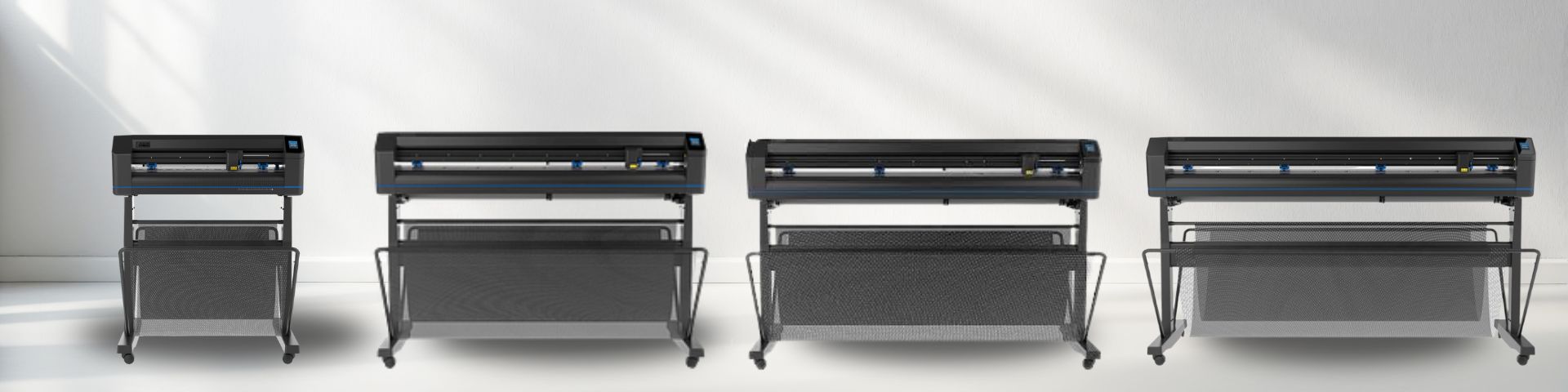
Summa S One series cutting plotters

The Summa S One series is the reliable and innovative solution for all your cutting applications. Designed with years of expertise and the latest technologies, this series offers unparalleled precision and efficiency.

Roland CAMM-1 GR2 Series Large Format Vinyl Cutters

The Summa S One Series combines rugged construction, fast cutting with trailing blades and advanced alignment systems. Designed for signage, vehicle advertising and print & cut workflows, they deliver reliable output with sharp contour cuts and excellent tracking.

Key features:


  • Drag knife cutting head with TurboCut and tangential emulation modes for sharp corners and detailed contours.
  • Cutting power up to 600 grams (standard models), with the FX variant (D140 FX) offering 400 grams.
  • OPOS (Optical Positioning System) for contour alignment, with OPOS X / OPOS Xtra, barcode job recognition and Y line compensation for accurate printing and cutting.
  • High speed: up to 1,131 mm/sec diagonally, with accelerations up to 3 G.
  • Exceptional media tracking: accuracy within ± 0.1 mm over roll lengths up to ~ 8 m on media widths up to ~ 760 mm.
  • Multiple widths available: approx. 60 cm, 75 cm, 120 cm, 135 cm, 158 cm (23-62″) models.
  • Connectivity and software: USB, Ethernet, WiFi (in many regions), software such as Summa GoSign, CutterControl, plug-ins for Mac/PC.

Frequently Asked Questions

What is the difference between the standard S One models and the FX variant (especially D140 FX)?

The FX variant (e.g. S1 D140 FX) differs primarily in cutting power and pinch roller configuration. While standard S One models have up to 600 grams of down force, the D140 FX model offers up to 400 grams. In addition, the FX model has fixed pinch roll positions, meaning it supports a set of media widths rather than fully freely adjustable pinch rolls. This makes FX slightly less flexible for minimizing margins on large or awkward media widths, but it may be sufficient (and more cost-effective) if your media widths are consistent and you rarely need very large or irregular formats.

How accurate is contour cutting and alignment?

The S One Series uses Summa's OPOS (Optical Positioning System) system, including OPOS X and OPOS Xtra. This reads registration marks (barcodes, X lines, Y lines) and can compensate for distortions such as slight shrinkage or stretching, which is especially important for printed graphics. Tracking accuracy is specified at about ±0.1 mm over rolls up to ~8 m long (for media widths up to ~760 mm). For wider media or rolls longer than that length, performance is still good, but warranty may be reduced. In general, users can expect very tight contour cuts, even for detailed designs.

Which model should I choose based on my production volume and media size?

The choice depends on a few variables:

  • Media width: If you work primarily with small to medium widths (e.g., up to ~75 cm), the S1 D60 or D75 may be adequate. For larger widths (e.g., banners, wide wraps), the D120, D140 or D160 offer more capacity.
  • Required cutting force: If you regularly cut thick laminated material or hard media, go for standard models with 600 g force. If your work is lighter/uniform, versions with FX or lower power may be sufficient.
  • Type of job (printing & cutting, contour cutting): For frequent contour cutting, barcode workflows, small stickers, OPOS Xtra, etc. become important. Efficient processing of long rolls also helps in higher throughput.
  • Speed & Utilization: If the workload is heavy (many jobs per day, long rolls), investing in a larger, more capable model will save time and reduce downtime.

Can these cutters handle thick or special materials?

Yes, to a certain extent. The standard 600-gram down force models can cut difficult media such as laminated vinyl, flock/flex, and in some cases even sandblast film with optional blades (≈ 0.8 mm thickness). However, these are drag knife machines, not true tangential knives, which means that very stiff or thick substrates (especially stiffer cardboard or thick plastics) can be more challenging. For that, a tangential or motorized blade system may be more appropriate. But for many signage/flexible media, the S One performs extremely well.

What software and workflow integration is available?

Summa provides GoSign software as a base, along with Summa CutterControl. There are plugins for design applications such as Adobe Illustrator, CorelDraw and Mac/PC compatibility. The OPOS system's barcode recognition allows you to automate contour cutting tasks. Connections via USB, Ethernet and often WiFi (depending on region) enable integration with network workflows. Overall, the S One is well suited for modern print & cut environments.

What about maintenance - blade replacement, cleaning, service?

Maintenance is pretty simple. Knife holders are designed so that you can quickly change regular blades, thicker blades or other tools. Meshing and calibration for OPOS sensors must be kept clean. Grain rollers must be kept free of dirt; media sensors and guides must be cleaned regularly. Spare parts (blades, rollers, etc.) are widely available through Summa and authorized dealers. In addition, the drag knife mechanism has fewer moving parts than a full tangential head, which often translates into less maintenance. Manuals provide detailed instructions.

What are the warranty and local service options?

Warranty usually includes parts for a specified period (usually two years, depending on region). Service support is usually available through Summa's local or regional dealers. If you buy through a reputable dealer, check what installation, training and spare parts availability are included. It is also wise to check service response times in your country/region.

What are the operating and power requirements?

The S One cutters operate with a standard global power supply: 100-240 VAC, 50/60 Hz. Ambient temperature is recommended between 15-35 °C. For best performance, ensure a stable power supply, a clean environment and adequate ventilation.

What are the operating costs - energy, consumables, degree of blade wear?

Energy consumption is moderate; the machines consume more power during cutting than in standby, but nothing extreme for a cutter of this class. Consumables include cutting blades (standard, thick, optional special cutting blades), sanding rollers, pinch rollers and media sensors. Blade wear depends on media type and use: sticky vinyls vs. laminated or rough surfaces will cause the blades to wear faster. Using proper settings (pressure, speed) and keeping the blades sharp maximizes their life. Accurate cutting also reduces material waste, which in many cases is a greater cost than the blades themselves.


Documents

Summa Roll Cutter Brochure (NL)
Download Now

Data Table

Available models

S1 D60, S1 D75, S1 D120, S1 D140 (and D140 FX variant), S1 D160

Maximum cutting widths

~60 cm (23″), 75-76 cm (29-30″), 120 cm (47″), 135-150 cm (53-60″), 158-169 cm (62″) (depending on model)

Cutting force (downforce)

0-600 grams in increments of 5 grams (standard models); FX model up to 400 grams

Speed and acceleration

diagonal up to 1,131 mm/sec; diagonal acceleration up to ~3 G

Accuracy when tracking/aligning

± 0.1 mm over rolls with a length of up to ~8 m (for media widths ≤ ~760 mm); slightly less guarantee for wider media or very long rolls

Connectivity & software

USB, Ethernet; WiFi in many regions; GoSign cutting software, Summa CutterControl, plug-ins for design apps

Why Dimix?

  • Ordered today before 15:30; delivered tomorrow
  • No shipping costs from 290 €
  • Net prices after login
  • Extensive advice
  • Experienced technical service